

*If some of the trading vocabulary feels unfamiliar, you can start with my complete free course, Essentials of Trading course, which explains the foundations step by step before moving into trading systems like NNFX.
VP’s Place Among the Great Trading-System Creators
Patrick, better known to his audience as VP, is the creator behind No Nonsense Forex, or NNFX. His work deserves to be discussed alongside influential system builders—not because their methods are identical, but because each tried to create an organized way of interpreting uncertain markets.
Bill Williams developed a broad methodology combining technical analysis, market structure and chaos theory. His work included tools such as the Alligator, Fractals and the Awesome Oscillator. Jim Brown of JAGFX has similarly presented rule-based forex methods designed to be understood by ordinary retail traders.
VP’s contribution is different. He did not simply publish a chart setup and call it a system. He introduced a framework in which indicator selection, historical testing, volatility, position sizing and trade management have to function together.
That distinction is what many strategy creators miss.
What Timeless Trading Systems Have in Common
A durable trading approach cannot depend entirely on one temporary market pattern, one indicator or one unusually attractive entry signal.
Markets change. Volatility expands and contracts. Currency pairs behave differently. A setup that looks impressive during one trend may become unreliable when conditions change.
A complete system therefore needs rules for several separate decisions:
- When market conditions qualify for consideration
- What confirms or rejects a possible entry
- How exposure is determined
- Where risk is limited
- How an open position is managed
- What causes the position to be closed
This is why a system is more than a signal. The signal is only one decision inside a larger process.
The Real Genius of NNFX Is Not a Single Indicator
NNFX is frequently misunderstood as an online search for the “best” confirmation indicator.
That interpretation misses the point.
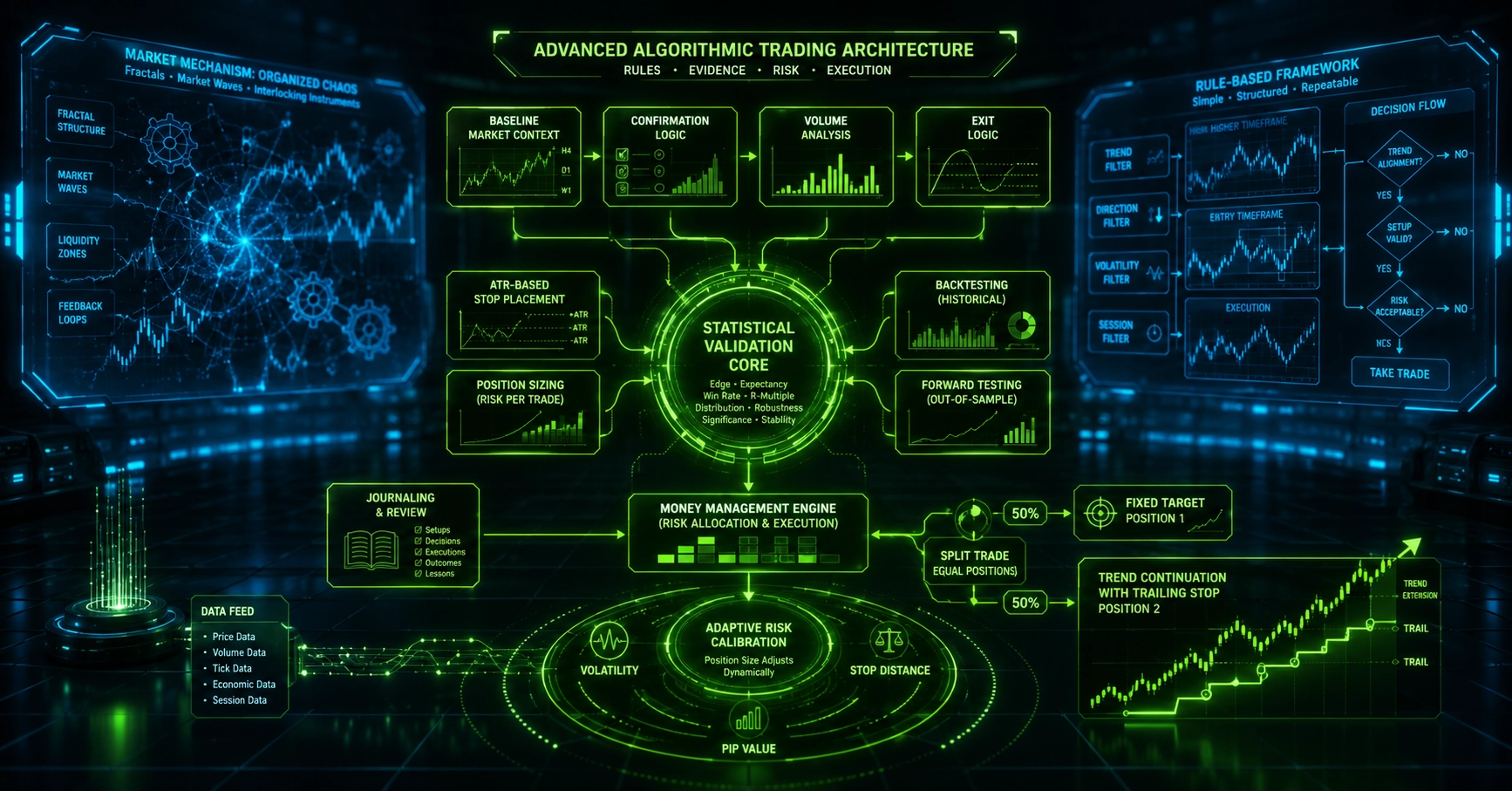
VP describes the algorithm as a structure traders use to build their own systems. Public NNFX material discusses several components, including ATR, confirmation indicators, an exit indicator, a baseline and volume logic.
The real value of the NNFX trading system is not hidden inside any individual indicator. It comes from forcing every component to perform a defined job within a tested process.
An indicator combination that looks convincing on a few charts has not proved anything meaningful. It only becomes relevant after its rules have been applied consistently to a sufficiently broad historical sample.
Statistical Edge and Money Management Must Work Together
A measurable statistical advantage and a coherent money-management model are separate requirements.
Neither can replace the other.
A strategy may identify useful market conditions but still expose the account inconsistently. Conversely, careful position sizing cannot repair an entry process that has no measurable advantage.
This is one of VP’s most important ideas: technical analysis should not be separated from trade management. Entry rules determine when a position may be considered, while risk rules control the consequences when the market behaves differently from the historical sample.
For beginners, this is a useful correction to the usual internet narrative. Finding an indicator is not the final task. It is barely the beginning.
If you want structured foundations instead of piecing things together, a beginner trading course can help you understand testing, terminology and risk concepts before you attempt to evaluate a complete methodology.
Backtesting: Proving the Strategy Before Risking Real Money
Backtesting applies fixed rules to historical market data. Its purpose is not to produce a beautiful equity curve. It is to determine whether the proposed rules created a measurable and repeatable pattern.
A useful test asks questions such as:
- Were the rules applied without hindsight?
- Did the method behave similarly across different periods?
- Were transaction costs and losing sequences considered?
- Did one currency pair create most of the positive result?
- Was the sample large enough to justify a conclusion?
VP’s educational material places substantial emphasis on testing indicators rather than accepting them because they are popular or visually convincing.
Why Testing Multiple Currency Pairs Matters
One attractive chart can be found for almost any indicator.
Testing across multiple currency pairs reduces the danger of mistaking a pair-specific coincidence for a broadly useful pattern. NNFX material also discusses monitoring a large group of major-currency combinations rather than depending on one preferred market.
Aggregate results provide a more realistic picture. They reveal whether the method is reasonably adaptable or whether its apparent edge came from one unusual market environment.
Forward Testing and Journaling
Backtesting studies known historical data. Forward testing examines how the completed rules behave on unseen data or under current market conditions.
This stage matters because historical testing can accidentally include hindsight, selective interpretation or overly optimized settings. A method that appears orderly in a spreadsheet may be difficult to execute consistently when new candles arrive one at a time.
A journal then connects the model to the trader’s actual decisions. It records whether the rules were followed, where deviations occurred and whether real-world outcomes remain broadly consistent with the tested sample.
Without a journal, it becomes difficult to distinguish between a problem with the system and a problem with its execution.
Why NNFX Uses an ATR-Based Stop
Average True Range measures recent price movement and is commonly used as an indication of volatility. An ATR-based stop therefore responds to the characteristics of the market instead of applying one fixed pip distance to every currency pair.
That matters because a fixed distance can represent very different conditions across two pairs. What is spacious in a quiet market may be extremely restrictive in a more volatile one.
The ATR does not predict direction. Its job in this context is to help standardize trade management around current volatility.
The Logic of Splitting a Trade Into Two Positions
The NNFX model is commonly presented as two positions that share the total planned exposure.
The first has a predetermined objective. The second is managed with the intention of remaining involved if a longer movement develops. Public explanations of the model commonly describe each part as representing roughly half of the complete setup’s planned risk.
Position One: A Defined Objective
The first position reduces dependence on predicting the total length of a market move.
Rather than expecting every trend to continue indefinitely, the system defines an objective in advance. This creates a consistent management rule and prevents the entire outcome from depending on an unusually long trend.
Position Two: Room for Extended Trends
The second position serves a different purpose. It maintains exposure beyond the first objective and is managed according to the system’s exit rules.
Most market movements will not become exceptional trends. The framework does not require them to. The second position exists so that the system can remain involved on the less common occasions when a movement continues.
Updating a trailing stop at a scheduled daily interval also limits reactions to every small intraday fluctuation. The trade-off is unavoidable: a loose stop returns more open progress during a reversal, while an excessively tight stop may close the position during ordinary market noise.
Position Sizing Is About Risk, Not Equal Lot Sizes
Equal lot sizes do not automatically create equal exposure.
Currency pairs have different pip values, and ATR-based stop distances vary with volatility. Position sizing must therefore consider four variables:
- Account equity
- The predefined percentage allocated to the complete setup
- The stop-loss distance
- The pair’s pip value
The purpose is not to maximize the size of a position. It is to keep relative exposure consistent even when the market, stop distance or account equity changes.
Percentage-based sizing also allows the framework to scale with the account. The monetary amount changes, but the proportion of equity placed at risk remains governed by the same rule.
This is a structural concept, not a guarantee of favourable results. Percentage risk can standardize exposure, but it cannot prevent losses or prove that the underlying strategy has an edge.
NNFX Is an Algorithm, Not a Collection of Indicators
The baseline, confirmations, volume component, ATR, exit logic and position-sizing rules are not independent decorations.
They form a sequence of decisions.
Remove the testing, and the indicators become assumptions. Remove position sizing, and exposure becomes inconsistent. Remove exit rules, and the trader is left improvising after entry.
That is the difference between copying NNFX and testing it.
Copying means downloading settings from a forum and assuming somebody else’s conclusions will transfer automatically. Testing means defining every rule, applying it to historical data, checking it on unseen data and recording the results without quietly changing the method after an inconvenient outcome.
Why Discipline Is Part of the Statistical Edge
A backtest is only relevant when the real-world execution resembles the rules used during the test.
Changing position sizes, skipping qualifying setups, taking untested entries or interfering with exits creates a different strategy. The original statistics can no longer describe it accurately.
In that sense, discipline is not a motivational slogan. It is a requirement for preserving the conditions under which the data was produced.
A System Designed to Operate Under Uncertainty
No framework can know exactly what the next market movement will be.
NNFX is notable because its architecture does not require certainty. It combines filters, volatility-adjusted stops, predefined exposure, partial position management and systematic exits.
The lasting lesson of the NNFX trading system is therefore not that a certain indicator predicts the market. It is that uncertainty should be addressed through evidence, consistent definitions and controlled decision-making.
The Real Legacy of VP’s NNFX Method
VP’s primary contribution is not the discovery of a magical indicator.
It is the presentation of a complete testing and money-management framework that encourages traders to think statistically rather than judge a method from a handful of charts.
That puts his work within a broader tradition of system creation represented by educators such as Bill Williams and Jim Brown. Readers can explore VP’s original material at No Nonsense Forex, Jim Brown’s work at JAGFX and the Bill Williams methodology through Profitunity. Their approaches differ, but each demonstrates why a trading method must be understood as an organized framework rather than a mysterious entry signal.
Tags: NNFX, No Nonsense Forex, VP Trading, Forex Education, Trading Systems, ATR, Backtesting, Position Sizing, Risk Management, Algorithmic Trading