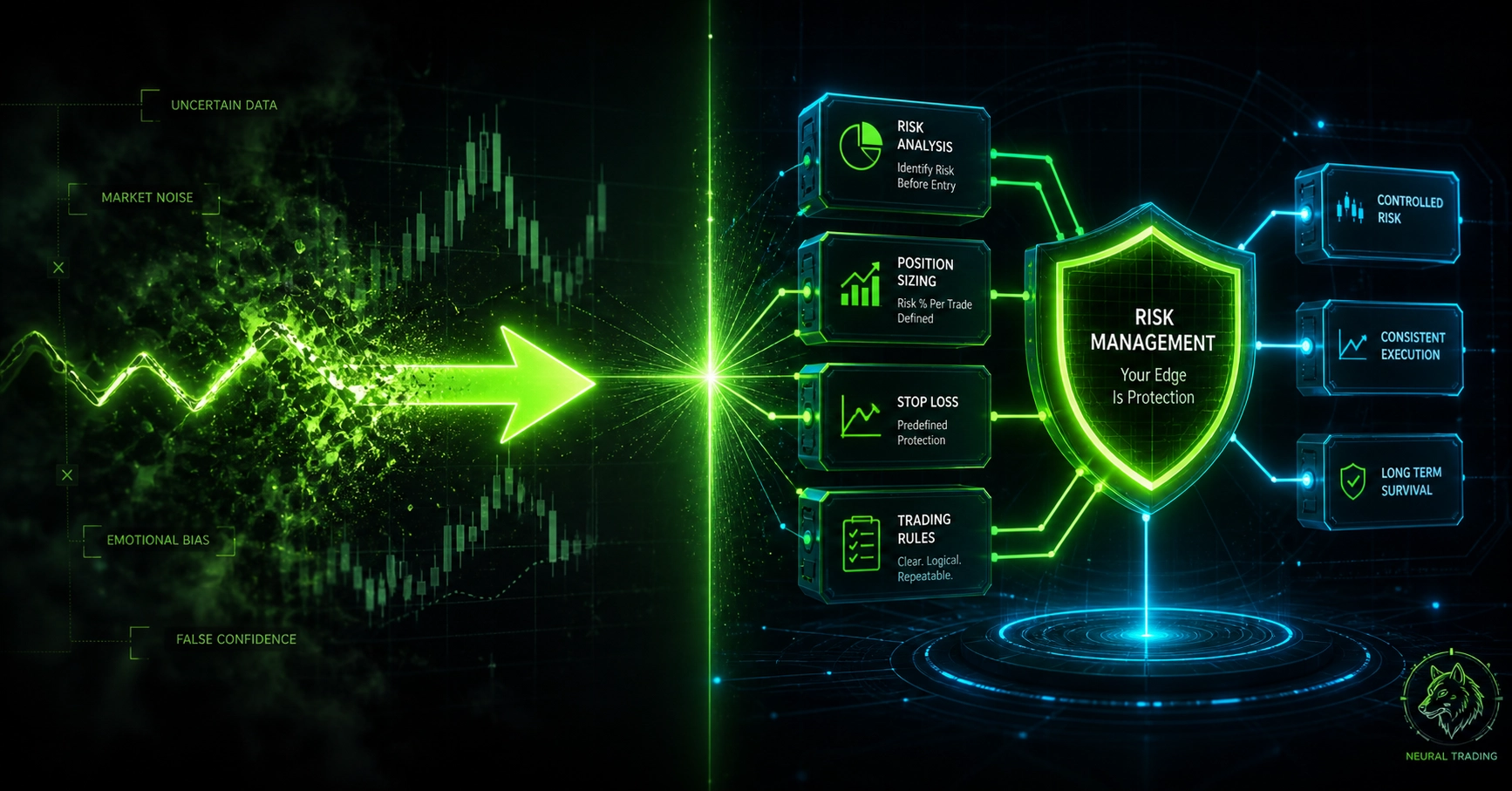

Most beginner traders lose money before risk management becomes a serious topic in their learning process. That is not because every beginner is careless, impatient, or “not built for trading.” It usually happens because beginners are introduced to trading in the wrong order.
They often learn about charts before they learn about risk. They hear about entries before position sizing. They see people talk about market direction before anyone explains what can happen when the market does something ordinary, boring, and inconvenient: move against them.
Risk management sounds like the serious chapter people plan to read later. The problem is that trading does not wait politely for later.
*All key terms used in this article are defined and always available in the Trading Glossary and can be consulted at any time.
Beginners Usually Start With the Most Exciting Part
The first thing most people notice about trading is price movement. A chart goes up, then down, then up again. It looks visual, active, and almost game-like.
That makes the entry feel like the main event.
New traders naturally ask questions like:
- Where should I enter?
- Is this going up or down?
- What indicator should I use?
- What setup is best?
These questions are understandable, but they skip the foundation. A trade is not only a prediction about direction. It is also an exposure to uncertainty.
That distinction matters. A person can have a reasonable idea and still take too much risk. A trade can make sense conceptually and still be poorly managed. The market does not reward someone just because their explanation sounded confident.
Risk Management Feels Boring Until It Becomes Personal
Risk management rarely feels urgent in the beginning. It sounds like paperwork. It sounds like the safety video before the roller coaster.
But in trading, risk is not a side topic. It is the environment.
FINRA explains that all investments involve some degree of risk, including the possibility of losing value, even substantially, depending on the product and market conditions. That basic idea applies directly to trading: risk is not an unusual event; it is built into participation.
The issue is that many beginners only become interested in risk after experiencing a loss that feels larger than expected. Before that point, risk management can seem like a technical detail. After that point, it becomes the thing they wish they had learned first.
The Early Focus Is Often on Being Right
One of the biggest beginner traps is believing that trading is mainly about being right.
Being right feels good. It gives the impression that the market has been understood. But trading is not a school quiz where the only outcome is correct or incorrect.
In trading, the size of the outcome matters. The frequency of exposure matters. The amount at risk matters. The trader’s ability to continue learning matters.
A beginner can become so focused on proving a market opinion that they ignore the more important question: “What happens if this idea is wrong?”
That question is not negative thinking. It is the beginning of risk awareness.
Small Mistakes Can Become Large Lessons
Beginners often underestimate how quickly small decisions can connect to larger consequences.
One trade may not seem like a big deal. Then another trade follows. Then a trader adjusts their plan because they “just want to get back to even.” Then they increase activity because doing something feels better than sitting still.
This is how many beginners drift from learning into reacting.
The market does not need a trader to make one dramatic mistake. Often, the damage comes from ordinary mistakes repeated without a structure:
- Trading without knowing the risk before entering
- Changing decisions mid-trade without a clear reason
- Increasing exposure after a frustrating result
- Treating recent outcomes as proof of skill or failure
- Confusing activity with progress
None of this makes someone foolish. It makes them new.
Why Risk Management Is Hard to Learn Alone
Risk management is difficult because it is not only one concept. It connects several ideas that beginners may not yet have organized.
A beginner has to understand:
- What risk means in practical terms
- How uncertainty differs from prediction
- Why position size matters
- Why losses are part of the trading process
- Why consistency is impossible without limits
- Why capital preservation is part of learning
That is a lot to piece together from random videos, comment sections, and half-finished explanations.
This is where structure matters. If you want structured foundations instead of piecing things together, a beginner trading course can help organize the basics in the right order: terminology, market mechanics, risk concepts, and realistic expectations before advanced ideas get involved.
The point is not to rush into trading. It is to understand what you are looking at before you attach money, emotion, and pressure to it.
Beginners Often Confuse Confidence With Preparation
Confidence is easy to borrow from other people.
A clean chart, a strong opinion, or a convincing explanation can make a beginner feel prepared. But preparation is not the same as excitement.
Real preparation is quieter. It looks like knowing what a term means. Knowing what can go wrong. Knowing why a trade idea is not automatically a trading plan. Knowing that uncertainty does not disappear just because someone online sounds certain.
This is why beginners can feel confident and still be unprepared. Their confidence comes from exposure to trading content, not from understanding trading risk.
That difference can be expensive.
Risk Management Comes Before Market Sophistication
Many beginners believe they need more advanced tools.
More indicators. More screen time. More patterns. More market commentary. More opinions from people with dramatic thumbnails and suspiciously clean desks.
But sophistication is not the same as foundation.
Before a beginner worries about advanced analysis, they need to understand the basic relationship between risk, uncertainty, and decision-making. Without that, every new tool becomes another way to take poorly understood risk.
Risk management does not make trading simple. It makes the learning process more grounded.
Losing Money Is Not the Tuition Plan
Some people describe early trading losses as “tuition.” That phrase can be misleading.
Yes, people often learn from mistakes. But that does not mean large or repeated losses are a necessary rite of passage. Beginners should not treat losing money as proof that they are becoming experienced.
A better approach is to learn the core concepts before exposure becomes serious. Study the mechanics. Understand the language. Learn what risk means before the market teaches it in a less friendly voice.
Trading education should reduce confusion, not create false confidence.
The Better First Question
Most beginners start with: “How do I find better trades?”
A better first question is: “What do I need to understand before any trade makes sense?”
That question changes the learning path. It moves the beginner away from prediction-chasing and toward structure. It makes risk management part of the foundation instead of a repair job after something goes wrong.
Most beginner traders do not lose money before learning risk management because they lack intelligence. They lose because the trading world often presents the exciting parts first and the important parts later.
Risk management should not be later. It should be one of the first things a beginner learns.