
Introduction
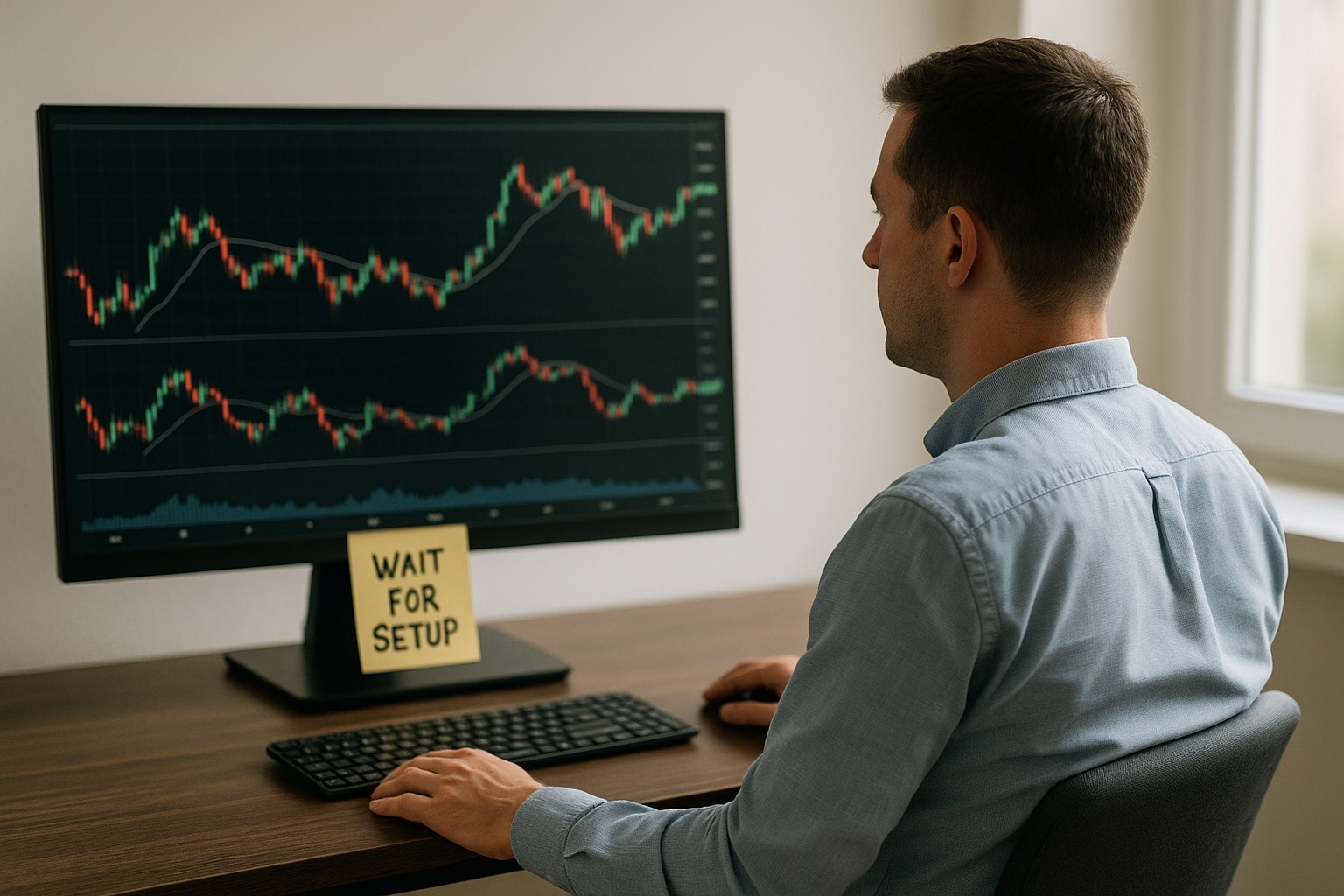
In trading, most of your edge isn’t made by clicking—it’s made by waiting. Patience is the discipline that allows you to sit through noise, ignore low‑quality setups, hold winners to target, and stay flat when conditions don’t match your playbook. Yet patience feels uncomfortable because it requires restraint in a high‑stimulation environment with constant price movement, alerts, and social comparison.
This article unpacks the psychology behind patience, why the inability to wait silently erodes expectancy, and how to build “active patience” through practical routines, journaling templates, cognitive tools, and system‑trading guardrails. Mastering patience isn’t passive—it’s a skill you train deliberately—and it compounds more than any indicator tweak ever will.
The Core Psychological Concept: What Patience Really Is in Trading
Patience is the ability to delay immediate action in favor of higher‑expectancy action. At its core, trading patience blends three cognitive and emotional capacities:
Delayed Gratification
Trading rewards restraint. The prefrontal cortex (logic, planning) must override limbic impulses (urgency, novelty seeking). Patience is the willingness to forego now for better.
Uncertainty Tolerance
Impatience stems from discomfort with not knowing. Traders fill silence with low‑quality trades to avoid the emotional tension of uncertainty. True patience requires emotional neutrality in ambiguity.
Boredom & Dopamine Regulation
Markets rarely offer A+ setups—but charts constantly stimulate. The brain seeks dopamine from micro‑actions: scrolling timeframes, forcing entries, managing trades unnecessarily. Patience requires rewiring dopamine to reward process, not action.
Two Forms of Patience Traders Must Master
| Type | Description | Example |
|---|---|---|
| Patience to Enter | Waiting for confluence and optimal price location | Passing on a near‑setup because ATR stretch violates playbook |
| Patience to Hold | Allowing a trade to reach target or exit criteria | Not taking +0.8R early when your data proves +2R average win |
Without both, even a strong system loses edge through skewed R‑multiple distribution and excess trade frequency.
Why Lack of Patience Sabotages Performance (Real Examples)
Premature Entry: “Close Enough” Syndrome
You see a trend pullback forming. Rules say wait for retest of the baseline and a confirming candle. Candle taps baseline, no confirmation yet—but you enter anyway.
Outcome: You take a full stop because the true signal hadn’t formed. Had you waited, you would’ve either avoided the trade or entered at better structure with smaller initial risk.
Exit Too Early: Bank‑the‑Win Bias
Your plan targets +2R with a 47% win rate. At +0.7R you feel the urge to secure green. You exit manually. Price then runs to target.
Consequence: By shaving winners early, your average win shrinks and expectancy collapses. The system needed patience to hold winners, not just to enter.
Over‑Trading: Filling the Void
A dull London session yields no setups. You enter a mediocre range‑break just to “stay active.” It chops and costs –1R.
Even if later you catch a valid +1.2R setup, the net result is negative only because you refused to sit on your hands.
System Trader Case: Parameter Hopping
Three flat weeks tempt you to tweak filters or indicators. You rush to “improve” instead of allowing sample size to play out. You invalidate your forward test mid‑run, destroying statistical integrity.
Holding Losers Longer Than Winners
Impatient with winners (exit early), patient with losers (hoping)… the inverse of a profitable profile. Impatience flips the expectancy equation against you.
Practical Methods & Exercises to Build Active Patience
The “A+ Setup” Filter
Before any entry, ask: Is this in my top 20% of setups?
If not, waiting preserves capital for when your edge is strongest.
Checklist (Gatekeeper):
- ☐ Does this match a named setup in my playbook?
- ☐ Is price at an optimal location (baseline + structure + ATR)?
- ☐ Do I feel urgency or calm clarity?
- ☐ Would I take this trade if I were already +2R on the day?
If “no” to any, you wait.
3‑Step Patience Breathing Protocol (90 Seconds)
Use before potential entries or when you feel “trigger‑itch.”
- 4‑2‑6 cycle x 6 rounds (inhale 4s, hold 2s, exhale 6s)
- Relax shoulders; widen vision beyond the monitor edges
- Self‑statement:
“Patience is participation. Waiting is a winning action.”
The “Time‑Boxed Observation” Exercise
Goal: Teach your brain that watching without acting is productive.
Each day, pick one 15‑minute block where trading is forbidden but chart observation and journaling are mandatory. Note the number of fake setups your old self would have forced. Over weeks, urge intensity drops dramatically.
Journaling Templates to Track Patience Skill
Patience Metrics to Log Daily
| Metric | Target | Notes |
|---|---|---|
| % Trades that matched A+ criteria | ≥ 80% | Forces quality over quantity |
| Winner Avg R vs Plan Avg R | ≥ 0.9 ratio | Shows if patience on exits holds |
| “No‑Trade Windows” honored | Yes/No | Helps avoid boredom trading |
Quick End‑of‑Day Reflection
- Did I wait for my signals?
- Where did impatience show up: entry, hold, or post‑loss?
- What emotion drove it: boredom, FOMO, urgency, frustration?
- What’s one micro‑adjustment for tomorrow?
Cognitive Reframes
- From “If I don’t trade, I’m falling behind” → “Capital preserved is capital multiplied later.”
- From “Nothing’s happening; this is a waste of time” → “Patience during chop protects my equity for trend days.”
- From “I need to be active” → “I need to be selective.”
Environment Design for Patience
- Remove stimulation: Fewer charts, hide PnL during session, turn off social feeds.
- Add friction to impulse: Require 2 clicks to place orders; disable hotkeys if they enable impulsive entries.
- Replace “do something” habits: When urge hits, perform a 30‑second reset ritual (stand up, stretch, sip water, 1 deep breath).
Holding Winners Exercise
Pick one setup each week you commit to never exiting early unless hard exit criteria triggers. Log the emotional curve minute‑by‑minute the first three trades. You’re training discomfort tolerance—the core muscle of patience.
Algorithmic / NNFX / System‑Trading Context
Patience for Data, Not Just Trades
System traders need patience during:
- forward testing
- drawdown periods
- low‑signal market regimes
Impatience leads to premature system modification, which corrupts data integrity and resets the statistical clock.
Forced Inactivity Rules
Embed structured patience:
- Locked Trading Hours: Trade only in defined windows; bot sleeps outside.
- Signal Quality Filter: EA only triggers entries when full confluence is present—no “close enough.”
- Cool‑Off Blocks: After a loss, bot waits X bars before next trade in same direction. This encodes patience automatically.
Trade Frequency KPIs
Track:
- Expected monthly number of trades vs actual
- Distribution of A‑, B‑, C‑grade signals
If frequency exceeds historical expectancy by >20%, impatience likely intruded.
NNFX‑Specific
- Maintain baseline + confirmation rules with zero exceptions.
- For exits, enforce ATR‑based trailing or fixed TP/SL as written—don’t override.
- Backtest seasonal patience: Some pairs/regimes produce fewer signals. Don’t force more.
Patience in Optimization & Iteration
Use PDCA with fixed review cadence (e.g., every 50 trades or monthly). You only modify a system on schedule, not emotionally.
Conclusion
Patience is not passive—it is a strategic edge. Every time you wait for alignment, allow a winner to reach full R, or stay flat on low‑quality days, you are compounding future returns through consistency. The market rewards those who can sit in discomfort without reacting. Train active patience daily, and you’ll separate yourself from nearly every retail trader who confuses activity with progress.
Wait well. Trade well.