
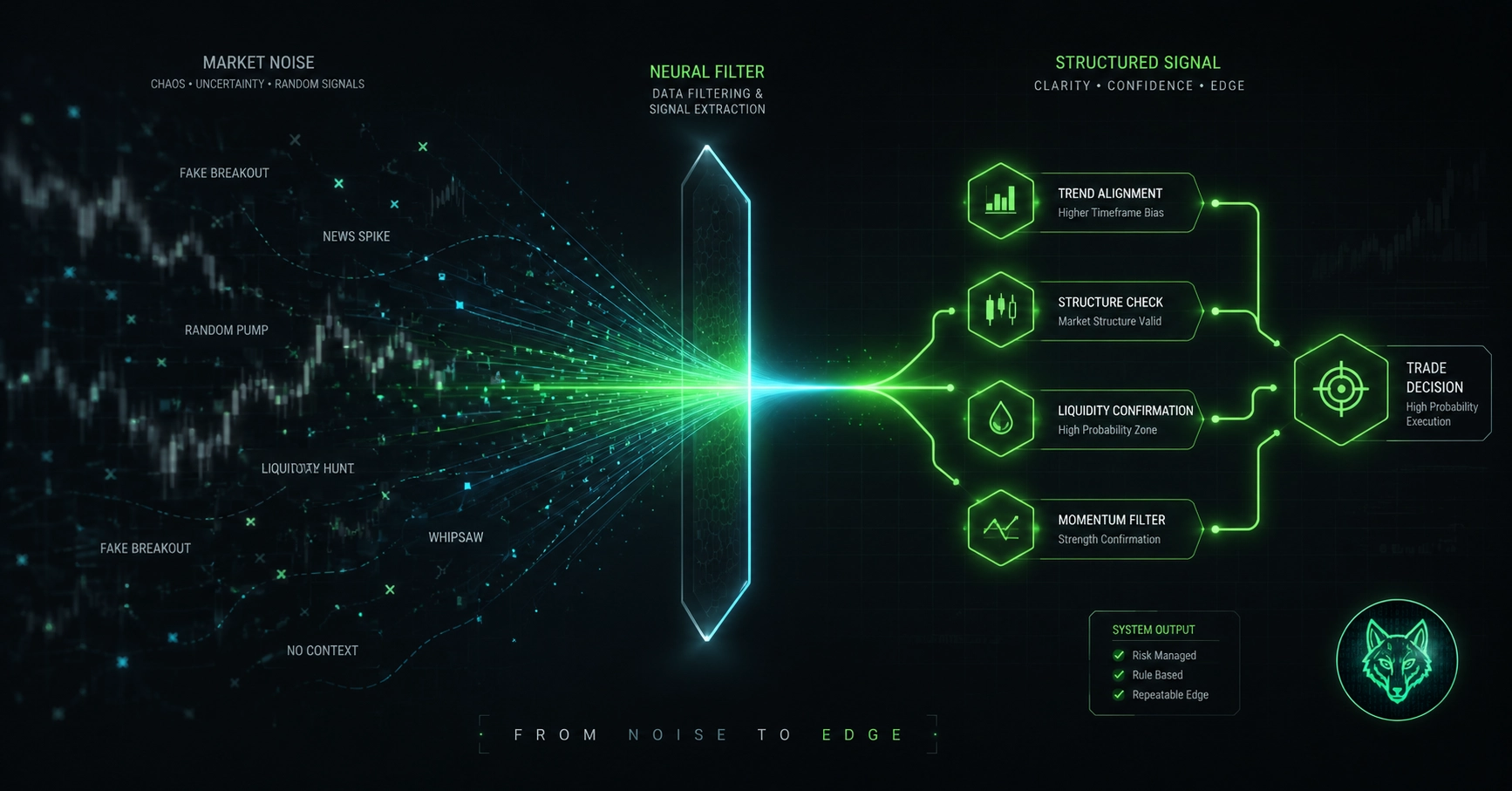

What is the NNFX method? In simple terms, NNFX stands for No Nonsense Forex, a rule-based trading framework mainly associated with forex trading. Instead of relying heavily on price action interpretation, chart patterns, or discretionary guesses, the NNFX method focuses on building a structured process using indicators, risk rules, testing, and repeatable decision-making.
That does not mean NNFX is a shortcut. It is not a magic formula, a signal service, or a promise of trading success. Its appeal is that it gives traders a clearer framework for making decisions, testing ideas, and reducing the amount of “I think this looks good” thinking that often causes confusion for beginners.
What Does NNFX Mean in Trading?
NNFX means No Nonsense Forex. It refers to a trading education style and methodology built around removing unnecessary noise from the decision process.
In trading, “noise” can mean many things:
- Too many opinions
- Too many chart patterns
- Random entries based on emotion
- Conflicting signals from different sources
- Strategies that cannot be clearly tested
The NNFX approach tries to replace that with rules. A trader following the method is not supposed to enter a trade just because price “looks strong” or because a pattern seems familiar. The idea is to build a structured system where each part of the decision has a defined purpose.
Who Invented the NNFX Method?
The NNFX method was developed by VP, whose real name is Patrick, according to the official No Nonsense Forex website. On his About page, he describes himself as a forex trader and says he has been trading forex since 2009.
His official website is No Nonsense Forex, which you can find here:
VP’s work became popular through his website, podcast-style content, and YouTube channel, where he explains the No Nonsense Forex approach and challenges many common retail trading ideas.
The Core Idea Behind the NNFX Method
The core idea behind the NNFX method is that trading decisions should come from a tested, repeatable system, not from constant interpretation that can drift in time.
Many beginners start by learning price action. They look for support and resistance, candlestick patterns, trendlines, breakouts, and reversals. None of these concepts are automatically useless. The problem is that beginners often apply them inconsistently.
One trader sees a breakout. Another sees a fakeout. One sees support. Another sees a weak area. One sees a reversal candle. Another sees nothing special.
That is where subjectivity becomes a problem.
NNFX tries to make the process more rule-based by using specific components that each answer a specific question. Instead of asking, “Does this chart look good?” the method pushes the trader toward clearer questions, such as:
- Is the market direction supported by the system?
- Is there confirmation?
- Is there a reason to avoid the trade?
- Is there a defined exit condition?
- Has this idea been tested over enough examples?
This is why many traders describe NNFX as more systematic than traditional discretionary price action.
NNFX Makes the Decision Process Clearer and More Verifiable
One of the main reasons traders are attracted to NNFX is that it aims to make decision-making clearer, less subjective, and more verifiable.
The important word here is “aims.” A rule-based method does not remove all uncertainty from trading. Markets remain uncertain. Losses still happen. Testing can be flawed. Indicators can lag. A system can behave differently in changing market conditions.
But compared with purely visual interpretation, NNFX gives traders something they can write down, test, review, and improve.
That is where the idea of a statistical edge comes in. A statistical edge means a trader is not relying on one perfect setup or one exciting chart. Instead, the trader is trying to evaluate whether a repeated set of rules has shown useful behavior across many examples.
This is very different from saying, “This setup looks obvious.”
Obvious to whom? Under what conditions? Over how many trades? With what exit rules?
NNFX encourages traders to think in those terms. That alone can be useful for beginners because it moves the conversation away from prediction and toward process.
If you want structured foundations instead of piecing things together from random videos, a beginner trading course can help you understand the basic language first: risk, entries, exits, testing, indicators, market conditions, and why no method should be treated as a guarantee.
The Subjectivity of Price Action Methods
Price action methods are popular because they look clean. A chart with candlesticks, support, resistance, and trendlines feels simple. But simple-looking does not always mean simple to apply.
The challenge is that price action often depends on interpretation. For example:
- Where exactly does support begin and end?
- How many touches make a level important?
- Is a candle rejection strong enough?
- Is the trend still valid?
- Is the breakout real or just temporary movement?
Experienced traders may have clear personal rules for these questions. Beginners usually do not. They often redraw levels, change their bias, or explain the same chart differently after the fact.
NNFX appeals to traders who dislike that level of interpretation. It does not mean price action is “bad.” It means NNFX offers an alternative for traders who prefer a more mechanical decision structure.
The Main Components of the NNFX Method
The NNFX method is commonly described as an indicator-based framework with several categories working together. Community summaries of the method often list components such as a baseline, confirmation indicators, a volume indicator, an exit indicator, and volatility measurement.
A commonly shared NNFX flow chart also references elements such as confirmation signals, baseline agreement, ATR, volume agreement, and exit rules.
Here is the beginner-friendly version:
Baseline
The baseline helps define the broader market direction or trade filter. It is not meant to be decoration on the chart. It has a specific job in the decision process.
Confirmation Indicators
Confirmation indicators are used to support or reject a possible trade idea. In NNFX, confirmation is not supposed to be random. The trader chooses tools, defines rules, and tests them.
Volume Indicator
The volume component is used as another filter. Depending on the market and platform, volume can be interpreted differently, so beginners need to be careful not to treat it as a universal truth.
Exit Indicator
The exit indicator helps define when the system says the trade idea is no longer valid. This matters because many beginners spend far more time thinking about entries than exits.
ATR and Volatility
ATR, or Average True Range, is commonly used in NNFX discussions as a way to account for volatility. The broader point is that market movement changes, and a system needs rules that recognize that.
Why Traders Are Attracted to the NNFX Method
Traders are attracted to NNFX because it offers structure. For someone overwhelmed by chart patterns, social media opinions, and conflicting strategies, structure can feel like a relief.
The main appeal is not that NNFX makes trading easy. It does not. The appeal is that it gives traders a process they can define and review.
Traders often like NNFX because it encourages:
- Rule-based decisions
- Backtesting and forward testing
- Less emotional chart reading
- Fewer random trades
- A complete system instead of entry-only thinking
That last point matters. Many beginners search for entries as if entries are the whole game. NNFX pushes the idea that a trading method also needs filters, exits, risk rules, and testing.
Is the NNFX Method Beginner-Friendly?
The honest answer: conceptually, yes; practically, not always.
NNFX can be beginner-friendly because the logic is easy to understand: build rules, test them, avoid random decisions, and stop treating one indicator as a complete strategy.
But the actual work can be difficult for beginners. You need to understand what indicators do, how testing works, how market conditions change, and why a backtest is not automatically proof of future results.
A beginner can study NNFX, but should avoid treating it as a plug-and-play solution. The better approach is to first learn trading foundations, then study how rule-based systems are built.
Key Takeaways
The NNFX method stands for No Nonsense Forex, a trading framework developed by VP, also known as Patrick, from the official No Nonsense Forex website.
Its main idea is to reduce subjective decision-making by using defined rules, indicators, testing, and a complete system structure.
Traders use NNFX because it can make the trading process clearer, more organized, and easier to review than purely discretionary price action methods.
The method is not a shortcut, a guarantee, or a replacement for learning the basics. For beginners, its biggest lesson may be this: trading decisions should be clear enough to test, review, and explain without rewriting the story after every chart.