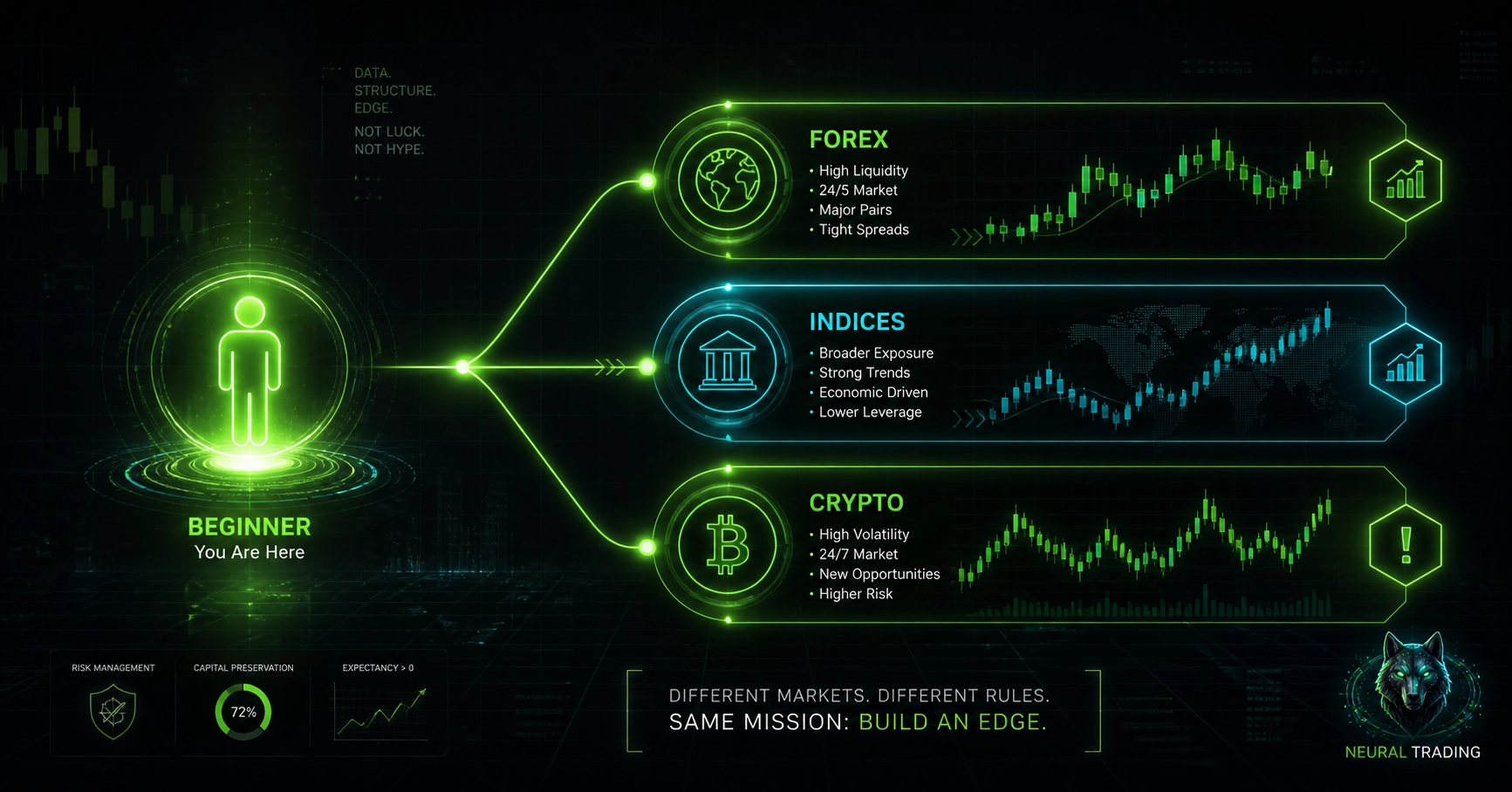

Forex, crypto, or indices: what should a beginner learn first? It is one of the most common questions new traders ask, and it makes sense. These three markets are everywhere online. Forex looks accessible. Crypto looks exciting. Indices look more connected to the “real economy.” And every corner of the internet seems to have someone explaining why their favorite market is the best place to start.
The honest answer is less dramatic: beginners should not choose a market because it looks exciting. They should choose the market that helps them understand trading foundations with the least confusion.
Before thinking about entries, indicators, platforms, or strategies, a beginner needs to understand what they are actually looking at. Markets are not video games. Price movement reflects supply, demand, liquidity, participants, expectations, risk, and sometimes plain old panic wearing a suit.
So let’s compare Forex, crypto, and indices from a beginner’s point of view.
*All key terms used in this article are defined and always available in the Trading Glossary and can be consulted at any time.
The Real Question Is Not “Which Market Is Best?”
There is no universal “best” market for beginners. A better question is:
Which market teaches the clearest foundations first?
A beginner should learn:
- How price moves
- What volatility means
- What liquidity is
- How trading costs work
- Why risk management matters
- How leverage can amplify mistakes
- Why market hours affect behavior
This is why jumping straight into the most exciting market is usually not the smartest starting point. Excitement and clarity are not the same thing. In trading, they are often complete strangers.
Forex: The Most Structured Starting Point
Forex, or the foreign exchange market, is where currencies are exchanged. Instead of buying a single asset alone, you always compare one currency against another. EUR/USD, for example, compares the euro against the U.S. dollar.
For beginners, Forex has one major educational advantage: it forces you to understand relationships.
You are not just asking, “Is this going up?” You are asking, “Is the base currency strengthening compared to the quote currency?” That simple structure teaches an important habit early: price is relative.
Why Forex Can Be Useful for Beginners
Forex can be a solid learning environment because:
- Currency pairs follow a clear base/quote structure
- Major pairs are generally liquid
- The market has defined sessions
- Economic news and central banks help explain movement
- Spreads and leverage introduce important trading mechanics early
This does not mean Forex is “easy.” It is not. The foreign exchange market carries serious risk, especially when leverage is involved. But from an educational standpoint, Forex gives beginners a structured way to learn how markets react to macroeconomic information, sessions, liquidity, and supply-demand changes.
In your Essentials of Trading course, Forex is introduced after the broader foundation of trading, money concepts, and market types, which is a logical progression for newcomers who need structure before detail.
Crypto: Interesting, Accessible, and Often Too Noisy
Crypto attracts beginners because it feels open, modern, and always available. The market trades 24/7, accounts are often easy to open, and the culture around crypto is extremely active.
That accessibility is also part of the problem.
Crypto can be useful to learn, but it is usually not the cleanest first market for a beginner. Price movement can be extremely volatile. News, social media, regulation, technology issues, exchange problems, and hype cycles can all influence behavior quickly.
What Beginners Should Understand About Crypto
Crypto is not just “digital money.” It includes different categories of assets, such as Bitcoin, altcoins, stablecoins, utility tokens, and other blockchain-based projects. Each category has different mechanics and risks.
The U.S. SEC’s Investor.gov warns that crypto assets involve issues such as custody, scams, volatility, and investor protection concerns, which makes basic education especially important before participating in that market.
For beginners, crypto is often better studied after understanding basic market structure elsewhere. Otherwise, it is easy to confuse movement with opportunity and hype with information.
Crypto is worth learning. It just should not be learned through chaos.
Indices: A Good Bridge Between Markets and the Economy
Stock indices represent baskets of companies. Examples include the S&P 500, NASDAQ 100, DAX 40, and CAC 40. Instead of focusing on one company, an index reflects a broader segment of the market.
This makes indices easier to understand conceptually than many beginners expect. You are not analyzing one stock’s earnings, management, lawsuits, product launches, or corporate drama. You are observing a group of companies together.
Why Indices Can Be Beginner-Friendly
Indices can help beginners understand:
- Broader market sentiment
- Economic cycles
- Risk-on and risk-off behavior
- How groups of assets move together
- Why markets react to inflation, interest rates, and employment data
They can also be more stable than individual stocks because one company usually has less influence on the whole index. That does not make indices safe. It simply means their structure is often easier to explain than single-stock movement.
For educational purposes, indices are a strong second or parallel market to study after the basic mechanics of Forex are understood.
So, What Should a Beginner Learn First?
A practical learning order would look like this:
1. Start With General Trading Foundations
Before choosing Forex, crypto, or indices, learn what trading actually is. Learn the difference between trading, investing, saving, and speculation. Learn what risk means. Learn how price moves. Learn what leverage does.
This is the part most beginners want to skip. It is also the part that prevents the most confusion later.
2. Learn Forex Basics First
Forex is often the clearest first market because currency pairs teach structure. Base currency, quote currency, exchange rates, sessions, spreads, liquidity, and macroeconomic drivers all appear very early.
That makes Forex useful as a classroom, even for someone who later prefers indices or crypto.
3. Add Indices Next
Indices are useful once you understand price movement and market hours. They help connect charts to broader economic conditions and market sentiment.
They are also a good way to understand how traders think beyond one isolated asset.
4. Study Crypto After That
Crypto should come after basic market structure, not before it. Its volatility, 24/7 schedule, custody issues, and hype-driven behavior can overwhelm beginners who do not yet have a framework.
Crypto is not “bad.” It is just a loud room. Learn how to listen before walking into it.
Where the Free Course Fits
If you want structured foundations instead of piecing things together from random videos, the free Essentials of Trading course is the logical next step.
It is built to take beginners through the basics in order: what trading is, how markets are organized, Forex, cryptocurrencies, brokers, platforms, trading mechanics, instruments, security, technical analysis, indicators, risk management, trading plans, and psychology. The goal is not to rush you into action. It is to help you understand what you are doing before risking money.
Start with the free Essentials of Trading course and build the foundations before choosing your preferred market.
Final Takeaway
A beginner should not choose Forex, crypto, or indices based on excitement, popularity, or online noise.
The better path is:
Foundations first. Forex basics next. Indices after that. Crypto once the structure is clear.