
*If some of the trading vocabulary feels unfamiliar, you can start with my complete free course, Essentials of Trading course, which explains the foundations step by step before moving into trading systems like NNFX.
The NNFX method has built a loyal following because it gives traders something most beginners badly need: structure.
Instead of staring at a chart, guessing where price might go, and calling it “market intuition,” NNFX pushes traders toward rules, filters, confirmations, and repeatable testing. That alone makes it different from a lot of noisy trading content online.
But markets are not frozen in time. Liquidity changes. Volatility changes. news reactions change. Spreads, execution, broker conditions, and trader behavior also evolve.
So the real question is not whether the NNFX method was useful when traders first discovered it. The better question is whether the NNFX method in modern markets still gives traders a reliable framework for building and testing rule-based systems.
The answer is: it can still be useful, but not automatically. The method is only as strong as the rules, indicators, testing process, and market conditions behind it.
What Is the NNFX Method and Why Traders Still Use It?
The NNFX method comes from VP, the creator of No Nonsense Forex, a well-known educational website and YouTube channel focused on a non-traditional approach to forex trading. VP deserves credit for popularizing a structured way of thinking about forex systems, especially for traders who were tired of random indicators, chart clutter, and emotional decision-making. His site positions No Nonsense Forex as a different way of approaching forex and encourages traders to follow a specific learning path rather than jumping around randomly.
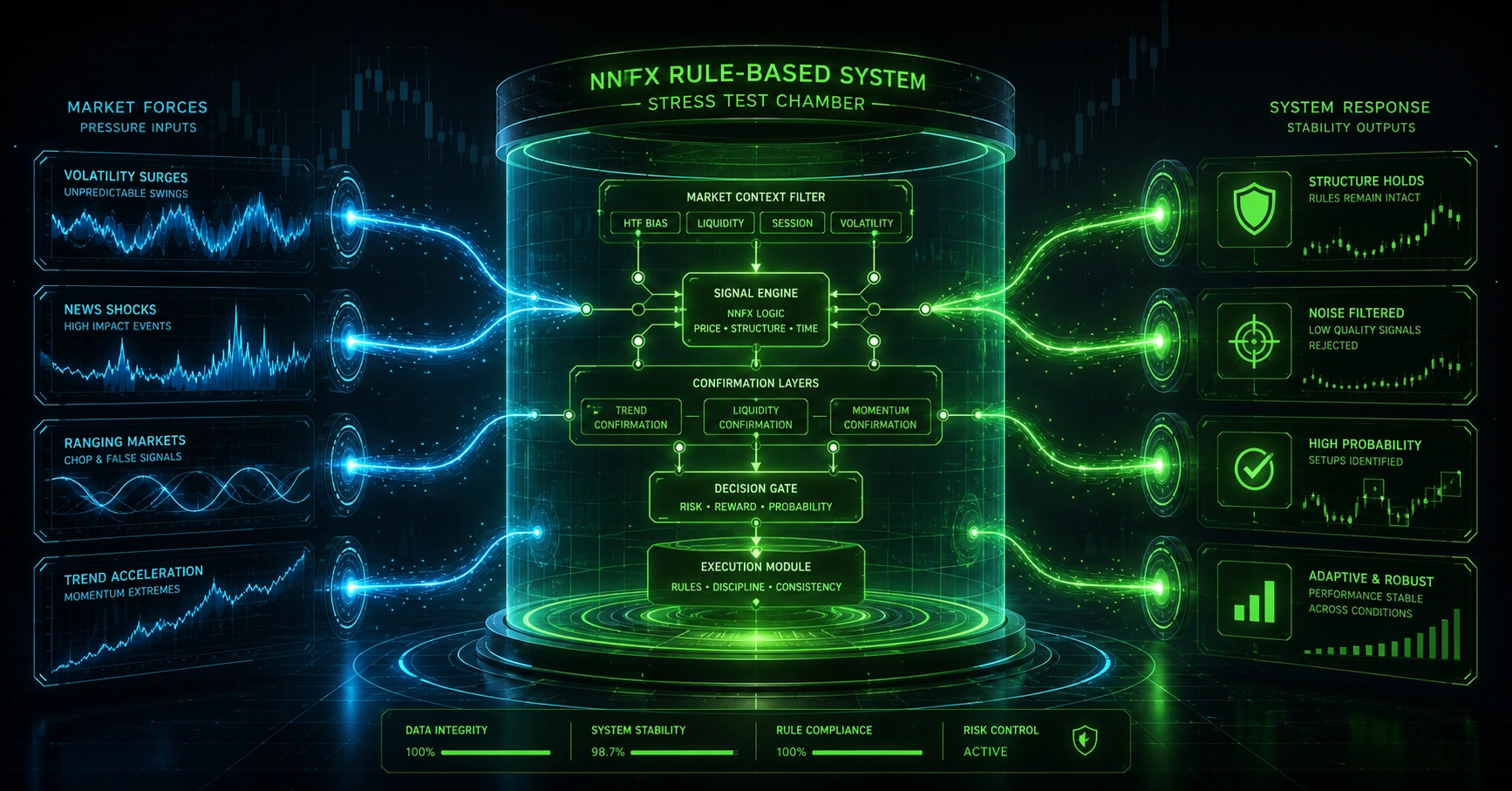
At its core, NNFX is a rule-based framework. Traders usually build a system around components such as:
- A baseline
- Confirmation indicators
- A volume filter
- An exit signal
- ATR-based risk and trade management
- A consistent testing process
That structure is why many traders still use it. NNFX does not ask traders to predict every candle. It asks them to define conditions, test those conditions, and follow the system only when the rules align.
That is a healthier starting point than “I saw a setup on social media.”
Why Modern Market Conditions Raise New Questions for NNFX Traders
Modern forex markets are large, highly electronic, and deeply connected to global macro events. According to the Bank for International Settlements, OTC FX trading reached about $9.6 trillion per day in April 2025, up from $7.5 trillion three years earlier.
That does not mean trading is easier. It means the market is active, competitive, and constantly processing information.
For NNFX traders, this raises important questions:
- Are older indicator combinations still useful?
- Do daily timeframe systems still respond well to modern volatility?
- Can a rule-based method handle sudden news-driven moves?
- How often should systems be retested?
- Does an indicator combination work across multiple pairs, or only in one specific historical window?
These are not reasons to abandon NNFX. They are reasons to test it more seriously.
Are Daily Timeframe Strategies Still Relevant Today?
Daily timeframe strategies can still be relevant because they reduce noise compared with lower timeframes. A daily candle compresses a full trading day into one data point. That can help traders avoid reacting to every minor intraday movement.
But daily charts also come with trade-offs.
Signals appear less often. Stops may be wider because ATR values are often larger. Some traders may find the pace too slow, especially if they are used to lower timeframe charts.
The daily timeframe is not “better” by default. It is simply different. Its value depends on whether the system has been tested properly on that timeframe, across multiple pairs, and through different market environments.
Do Traditional Indicators Still Work in Today’s Forex Markets?
Traditional indicators can still provide useful information, but traders need to understand what indicators actually do.
Most indicators do not predict the future. They transform past price, volume, or volatility data into a visual format. That can help traders classify market behavior, but it does not remove uncertainty.
A moving average can show trend direction. An oscillator can show momentum shifts. ATR can measure recent volatility. None of these tools knows what the next central bank statement will say.
This is where many beginners get confused. The question is not, “Does this indicator work?” The better question is, “Does this indicator add useful information inside a complete rule-based system?”
Why Rule-Based Trading Still Works in Uncertain Markets
Rule-based trading remains useful because uncertainty does not disappear. In fact, uncertainty is the normal condition of markets.
A rule-based system helps traders define what they will and will not do before the chart starts moving. That matters because without rules, every candle becomes an invitation to improvise.
The strength of rule-based trading is not that it guarantees a specific outcome. It does not. The strength is that it creates consistency. And consistency is what allows traders to test, compare, and improve a system over time.
A messy process cannot be measured clearly. A rule-based process can.
The Strength of NNFX: Filtering Out Weak Trade Setups
One of the strongest parts of NNFX is the filtering concept.
Instead of entering based on one indicator, NNFX traders usually wait for several conditions to align. The baseline, confirmation indicators, volume filter, and exit logic each serve a different purpose.
That does not make a setup certain. It simply means the system is designed to reject more low-quality conditions before a trade is considered.
This is important because many beginner traders do the opposite. They look for one reason to enter. NNFX forces the trader to ask whether enough separate conditions support the idea.
That extra friction can be useful.
The Weakness of NNFX: Not Every Indicator Combination Stays Effective Forever
The biggest weakness of NNFX is not the framework itself. The weakness is assuming that one indicator combination will remain useful forever.
Markets move through phases. A combination that looks clean during a trending period may struggle when price becomes choppy. A volume filter that seems helpful on one pair may add little value on another. An exit indicator may react too slowly in one regime and too quickly in another.
This is why traders should be careful with “set and forget” thinking.
An NNFX system is not finished just because it produced interesting historical results once. It needs to be reviewed, retested, and compared against new data.
Why Backtesting Matters More Than Ever for NNFX Traders
Backtesting is essential because NNFX systems contain multiple moving parts. When a method uses several indicators and filters, the trader needs evidence that the combination behaves reasonably over time.
Backtesting helps answer questions such as:
- How often does the system produce signals?
- Does one pair behave very differently from another?
- Does the exit logic match the entry logic?
- Does the system depend too heavily on one unusual market period?
- Does the strategy become unstable when settings are slightly changed?
Backtesting does not prove what will happen next. It simply gives traders a clearer view of how the rules behaved in the past.
That distinction matters.
The Problem With Testing NNFX Manually
Manual testing is useful for learning, but it becomes difficult when the system grows.
NNFX-style testing often involves checking the baseline, multiple confirmations, volume conditions, ATR values, exits, and trade management rules. Doing that manually across many pairs and years of data is slow.
It also introduces human error.
A trader may skip a signal. They may record a result incorrectly. They may interpret a borderline condition differently after a long testing session. They may unconsciously give special treatment to trades they “like.”
This is not because traders are lazy. It is because manual testing is repetitive and mentally draining.
That is one reason an NNFX testing/trading EA can be valuable. Not because automation magically improves a system, but because it can apply the same rules consistently and expose problems faster.
How Market Regimes Can Change the Performance of an NNFX Strategy
A market regime is simply a type of market environment.
For example, a pair may spend time in:
- A trending regime
- A ranging regime
- A high-volatility regime
- A low-volatility regime
- A news-sensitive regime
A system that performs reasonably in one regime may behave poorly in another. This is especially important for NNFX traders because many indicator-based systems depend on clean directional movement.
If market behavior changes, the same indicator combination may produce more false confirmations, late exits, or fewer usable setups.
This does not mean the method is broken. It means the trader needs to understand where the system is strongest and where it becomes weaker.
Trending Markets vs Ranging Markets: Where NNFX Can Perform Better
NNFX-style systems often make more sense in trending markets because the method usually tries to confirm directional movement before entry.
In a trend, filters can help keep the trader aligned with broader movement. In a range, the same filters may trigger late, reverse too often, or produce signals near poor locations.
That said, not every NNFX system is identical. Some indicator combinations may handle ranges better than others. Some may be more selective. Some may produce very few signals during choppy periods, which can be a strength or a limitation depending on the trader’s goals.
The key is not to assume. Test trending and ranging periods separately.
Can NNFX Still Work With Faster News-Driven Moves?
News-driven moves are one of the hardest areas for indicator-based systems.
Indicators react to price data. Major news can change price behavior before indicators have time to respond cleanly. This can create sudden spikes, gaps, spread changes, or candles that distort signals.
For NNFX traders, the question is not whether news exists. Of course it does. The question is whether the system has rules for handling it.
Some traders may avoid certain high-impact events. Others may include those periods in testing and accept the behavior as part of the system. Either way, the choice should be defined before trading, not improvised during a fast move.
Why Indicator Selection Is the Real Difference Maker
NNFX is not one fixed strategy. It is a framework for building a strategy.
That means indicator selection matters enormously.
Two traders can both say they use NNFX, but their systems may behave completely differently. One may use slow confirmations. Another may use faster confirmations. One may rely on a stricter volume filter. Another may use a looser exit.
The framework provides the structure, but the indicators define much of the behavior.
This is where many traders get stuck. They search for “the best NNFX indicators” instead of asking which indicators combine well, avoid duplication, and hold up under testing.
The real work is not collecting indicators. The real work is validating combinations.
Should Traders Adapt NNFX for H4 or H1 Timeframes?
Some traders adapt NNFX ideas to H4 or H1 charts because they want more signals or shorter holding periods.
That can be reasonable, but it changes the system.
Lower timeframes usually contain more noise. Spreads and execution can matter more. News spikes may affect signals more aggressively. A filter that behaves smoothly on the daily chart may become unstable on H1.
So yes, traders can explore H4 or H1 versions of an NNFX-style system. But they should not assume daily timeframe rules automatically transfer.
A lower timeframe version needs its own structure, testing, and expectations.
Why Every Timeframe Needs Its Own Separate Testing
This point deserves its own section because it is where many traders make mistakes.
A system tested on the daily chart has only been tested on the daily chart.
It has not been validated for H4. It has not been validated for H1. It has not been validated for M30.
Each timeframe changes the number of signals, the noise level, the ATR behavior, the reaction speed, and the role of spread. Even the same indicator settings can behave very differently.
This is why timeframe testing should be separated. Mixing results across timeframes can make a system look more reliable than it really is.
The Role of ATR-Based Risk Management in Modern Markets
ATR is one of the most practical parts of the NNFX framework because it adjusts to recent volatility.
Rather than using one fixed distance for every pair and every condition, ATR-based logic responds to how much a pair has been moving recently. That can make risk placement more consistent across different currency pairs.
But ATR is not a shield.
It does not prevent slippage. It does not predict news. It does not guarantee that a stop or target is well placed. It is a volatility measurement tool, not a safety device.
Used properly, ATR can make a system more structured. Used blindly, it becomes just another number on the chart.
How an NNFX Testing EA Can Help Validate the Method
An NNFX testing EA can help traders validate the method by applying rules consistently across historical data.
This is where our future NNFX testing/trading EA fits naturally.
The goal is not to tell traders which indicator combination to use. The goal is to help traders test their own NNFX-style rules more efficiently, compare results, and identify weaknesses that manual testing can easily miss.
A well-designed NNFX testing EA should help traders examine:
- Different indicator combinations
- Different currency pairs
- Different timeframes
- Different ATR settings
- Different exit logic
- Different market regimes
That does not remove the need for judgment. It gives the trader better information before making decisions.
Why Automation Can Reveal What Manual Trading Often Misses
Automation is useful because it is boring in the best possible way.
It does not get tired. It does not skip a candle. It does not change the rule because the chart “looks different this time.” It applies the same logic repeatedly.
That consistency can reveal uncomfortable truths.
A system that felt strong manually may show weak spots when tested across more pairs. An indicator that looked impressive on one chart may add little value across a larger sample. A rule that seemed harmless may reduce signal quality when applied mechanically.
This is not a bad thing. It is exactly what testing is supposed to reveal.
What Traders Should Test Before Trusting an NNFX Strategy
Before trusting an NNFX-style strategy, traders should test more than one attractive backtest.
They should examine whether the system remains stable across different conditions. They should also check whether the indicators are genuinely adding separate information or simply repeating the same type of signal.
Important areas to test include:
- Currency pair behavior
- Timeframe behavior
- Trending vs ranging periods
- High-volatility vs low-volatility periods
- Spread sensitivity
- Exit logic
- ATR settings
- Indicator overlap
- Forward testing after backtesting
No single test answers everything. But a structured testing process gives traders a clearer picture than opinion, screenshots, or community excitement.
Final Verdict: Can the NNFX Method Still Work Today?
The NNFX method can still be useful today, but only when treated as a testing framework rather than a shortcut.
Its strengths are still relevant: structure, filtering, rule-based thinking, ATR awareness, and systematic validation. Those ideas are not outdated.
But the weaknesses are also real. Indicator combinations can degrade. Market regimes can shift. Manual testing can introduce errors. Lower timeframes can behave differently. News-driven moves can distort signals.
So the best answer is balanced: the NNFX method in modern markets can still make sense, but traders need evidence, not assumptions.
That is exactly why an NNFX testing/trading EA is a logical next step. Not as a magic button. Not as a promise. But as a tool for traders who want to test rules properly before trusting them.
In modern forex, the edge is not in believing harder.
It is in testing better.