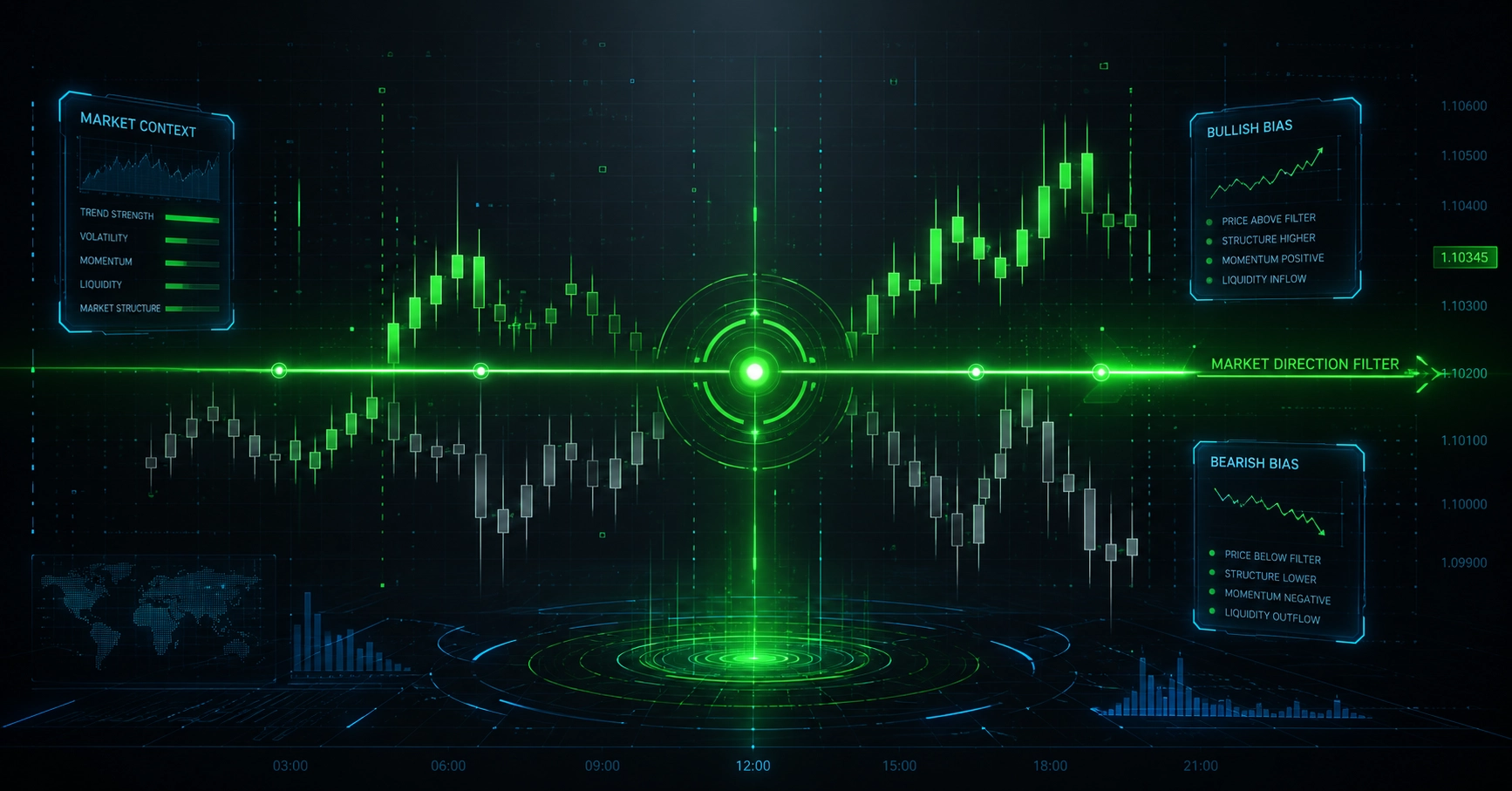

In the NNFX method, the baseline is one of the main tools used to define trade direction. It usually behaves like a trend filter, helping traders decide whether the market environment is more aligned with long ideas, short ideas, or no clear bias at all.
The baseline is often a moving average or a similar trend-following indicator. Its role is not to predict the future. It simply gives structure to what price is already doing.
That is why NNFX baseline trade direction matters so much. Without a directional reference point, beginners can end up reacting to every candle, every small move, and every indicator flicker.
Why Trade Direction Matters Before Any Entry Signal
A trade signal without direction is just noise with better branding.
Before thinking about entries, an NNFX trader needs to know whether the setup fits the broader rules of the system. Direction comes first because it creates context. A confirmation indicator may flash something interesting, but if it goes against the baseline rules, the setup may not qualify.
This helps beginners avoid a common mistake: treating every signal as equally important. In structured trading, not every signal deserves attention.
The Baseline as a Directional Filter, Not a Buy or Sell Button
The baseline should not be treated as a buy or sell button.
When price moves above or below the baseline, that does not automatically mean a trade should be taken. The baseline filters direction. It does not complete the full decision process.
A better way to think about it is this:
The baseline answers, “Which direction is currently allowed by the rules?”
It does not answer, “Should I enter right now?”
That difference matters. A baseline can help remove bad conditions from consideration, but it still needs support from the rest of the NNFX structure.
How Price Location Around the Baseline Shapes Trade Bias
Price location is one of the simplest ways the baseline shapes trade bias.
When price is above the baseline, the bias may lean toward long setups, depending on the full system rules. When price is below the baseline, the bias may lean toward short setups. When price is tangled around the baseline, the market may be unclear or choppy.
This does not mean price above the baseline is automatically “good,” or price below it is automatically “bad.” It means the baseline gives a consistent reference point so the trader is not guessing direction candle by candle.
Why Baseline Direction Helps Reduce Random Trade Entries
Random entries often happen when traders look for action before they look for structure.
The baseline helps slow that process down. Instead of asking, “Can I find a reason to trade?” the trader asks, “Does this setup fit the direction rules?”
That one shift can reduce unnecessary decisions. It also makes review easier. If a trader keeps taking setups that ignore baseline direction, the problem becomes visible in the journal or backtest.
The baseline is not there to make trading exciting. It is there to make decision-making less messy.
Baseline Crosses vs Baseline Continuation Setups
In NNFX discussions, traders often separate baseline crosses from continuation setups.
A baseline cross happens when price moves from one side of the baseline to the other. This may suggest a possible directional shift, but it still needs confirmation.
A continuation setup happens when price is already on the correct side of the baseline and the broader system rules still support that direction.
Both concepts can be useful, but neither should be treated casually. A cross can be late, messy, or false. A continuation setup can appear after a move has already stretched too far. This is why testing matters more than visual confidence.
How the Baseline Works With Confirmation Indicators
The baseline and confirmation indicators should not compete with each other. They serve different jobs.
The baseline defines directional permission. Confirmation indicators help decide whether the conditions support that direction. In a structured NNFX approach, the baseline is only one part of a larger checklist.
This matters because beginners often overload one indicator with too much responsibility. They expect the baseline to show trend, timing, strength, and exit quality all at once. That is asking too much from one tool.
If you want structured foundations instead of piecing things together from scattered videos and forum posts, a beginner trading course can help you learn what each component is supposed to do before you start testing combinations.
Why a Baseline Alone Is Not Enough for a Complete NNFX Trade
A baseline alone cannot define a complete NNFX trade.
It does not replace confirmation indicators. It does not replace volume logic. It does not replace exit rules. It does not replace ATR-based risk structure. It is one component inside a full framework.
This is where many beginners get stuck. They find a baseline that looks clean on a chart, then assume the job is done. But the real question is not whether the baseline looks nice. The question is how it behaves when tested with the full rule set.
The Problem With Choosing a Baseline by Eye
Choosing a baseline by eye is tempting because it feels simple.
You place an indicator on the chart, scroll back, and decide whether it “fits.” The problem is that the human eye is very good at spotting patterns after the fact. It is also very good at ignoring the ugly parts.
A baseline that looks smooth may react too slowly. A baseline that reacts quickly may create too much noise. A baseline that looks perfect on one section of a chart may behave poorly elsewhere.
Visual review can help with understanding, but it should not be the final decision-maker.
Why Different Currency Pairs Can React Differently to the Same Baseline
Currency pairs do not all move the same way.
Some pairs trend more cleanly. Some spend more time chopping around. Some react strongly to certain sessions or economic themes. Because of that, the same baseline can look excellent on one pair and awkward on another.
This does not automatically mean the baseline is bad. It means pair behavior matters.
The key is not to judge the baseline from one attractive example. The key is to see how it behaves across enough market conditions to make the review meaningful.
Should One Baseline Work Across Multiple Pairs?
Yes, one baseline can work across multiple pairs when judged on the aggregate of all pairs.
That does not mean it will behave beautifully on every pair. It means the baseline can still be valid if its overall historical behavior across the tested group is acceptable within the system rules.
This is an important distinction. Beginners often hunt for a baseline that looks perfect everywhere. That expectation usually creates frustration. Markets are not that tidy.
A stronger goal is consistency across the full testing basket, not perfection on each individual chart.
How Backtesting Validates Baseline Direction Rules
Backtesting helps turn baseline opinions into evidence.
Instead of saying, “This baseline looks good,” the trader can test how it behaves when the rules are applied consistently across historical data. Investopedia describes backtesting as using historical data to reconstruct trades that would have occurred under defined strategy rules, which is the basic idea behind validating any rule-based trading component.
For NNFX baseline trade direction, backtesting can help answer questions such as:
- Did the baseline keep trades aligned with the intended bias?
- Did it create too many unclear conditions?
- Did it behave differently across pairs?
- Did it work better as part of the full system than it looked on its own?
Backtesting does not prove what will happen next. It simply helps traders evaluate whether their rules have behaved coherently in the past.
Why Manual Baseline Testing Can Become Slow and Inconsistent
Manual testing has value, especially for learning. It forces the trader to slow down and understand the chart.
But it can also become slow and inconsistent.
A trader may apply rules slightly differently from one session to another. Fatigue can affect judgment. Missed candles, skipped setups, and inconsistent notes can distort the review.
This is especially true when testing many pairs, many baselines, and multiple rule combinations. Manual testing can teach the process, but it can become difficult to scale.
How an NNFX Testing EA Can Compare Baseline Performance Faster
An NNFX Testing EA can help compare baseline performance faster by applying the same rules repeatedly across historical data.
The important word here is “testing.” This is not about handing decision-making to a tool or treating automation as a shortcut. It is about reducing repetitive manual work so the trader can compare components more consistently.
A testing EA can help examine multiple baselines, pairs, and rule combinations without relying only on visual impressions. The trader still needs to understand the rules, review the logic, and avoid overfitting.
Speed is useful only when the rules being tested are clear.
Testing the Baseline With Confirmations, Volume, Exit Rules, and ATR Logic
A baseline should be tested inside the full NNFX structure.
That means it should be reviewed with confirmation indicators, volume logic, exit rules, and ATR-based structure. Testing the baseline alone may be interesting, but it does not show how the full system behaves.
A baseline that looks average by itself may work better when paired with strong confirmations. A baseline that looks excellent alone may become less useful once exits and filters are added.
The full system matters more than any single component.
What Traders Should Look for in a Strong Baseline Setup
A strong baseline setup is not about finding the prettiest line on the chart.
Traders should look for a baseline that supports clear directional rules, avoids excessive confusion around price, and fits logically with the rest of the system.
Useful qualities include:
- Clear directional bias
- Reasonable reaction to market movement
- Compatibility with confirmations
- Consistent behavior across a basket of pairs
- Rules that can be tested without guesswork
The goal is not magic. The goal is structure.
Final Takeaway: The Baseline Guides Direction, but Testing Builds Confidence
The baseline plays a central role in NNFX trade direction because it helps define bias before entry signals are considered.
But it is not a complete system. It is not a prediction tool. It is not a buy or sell button. It is a directional filter that needs to work with confirmations, volume logic, exit rules, and ATR structure.
The real value of the baseline comes from testing. When rules are tested across multiple pairs and conditions, traders can move away from chart opinions and toward a more structured review process.
That is where confidence should come from: not hype, not screenshots, and not perfect-looking examples, but clear rules tested consistently.